


Recently, I have discussed the feedback with some engineering leaders who read my newsletter. There was one common theme “we love the concepts you present, we would like to implement them in our company, but there is no space / culture / interest to make it happen”.
It resonated a lot. I remember my early times in the leadership, reading how Google, Spotify, and Amazon are managed - always frustrated about why we cannot do the same in our company.
Until I realized it’s not the company that is supposed to change. It is we, leaders, who drive this change, very often bottom-up.
You Manage System
As an engineering leader, you are essentially a system designer. You manage a complex socio-technical system—a web of people, processes, codebases, and infrastructure.
Early in our careers, we intuitively focus on technicalities: code, libs, APIs, UI components. But over time, we realize our work is on different levels too: tools and instruments (how these things are tied together) and finally, the social circuitry that includes the processes, standards, and communication patterns that guide how people work together.
The concept of three layers:
Layer 1: Technical Objects
Layer 2: Tools and Instrumentation
Layer 3: Social Circuitry
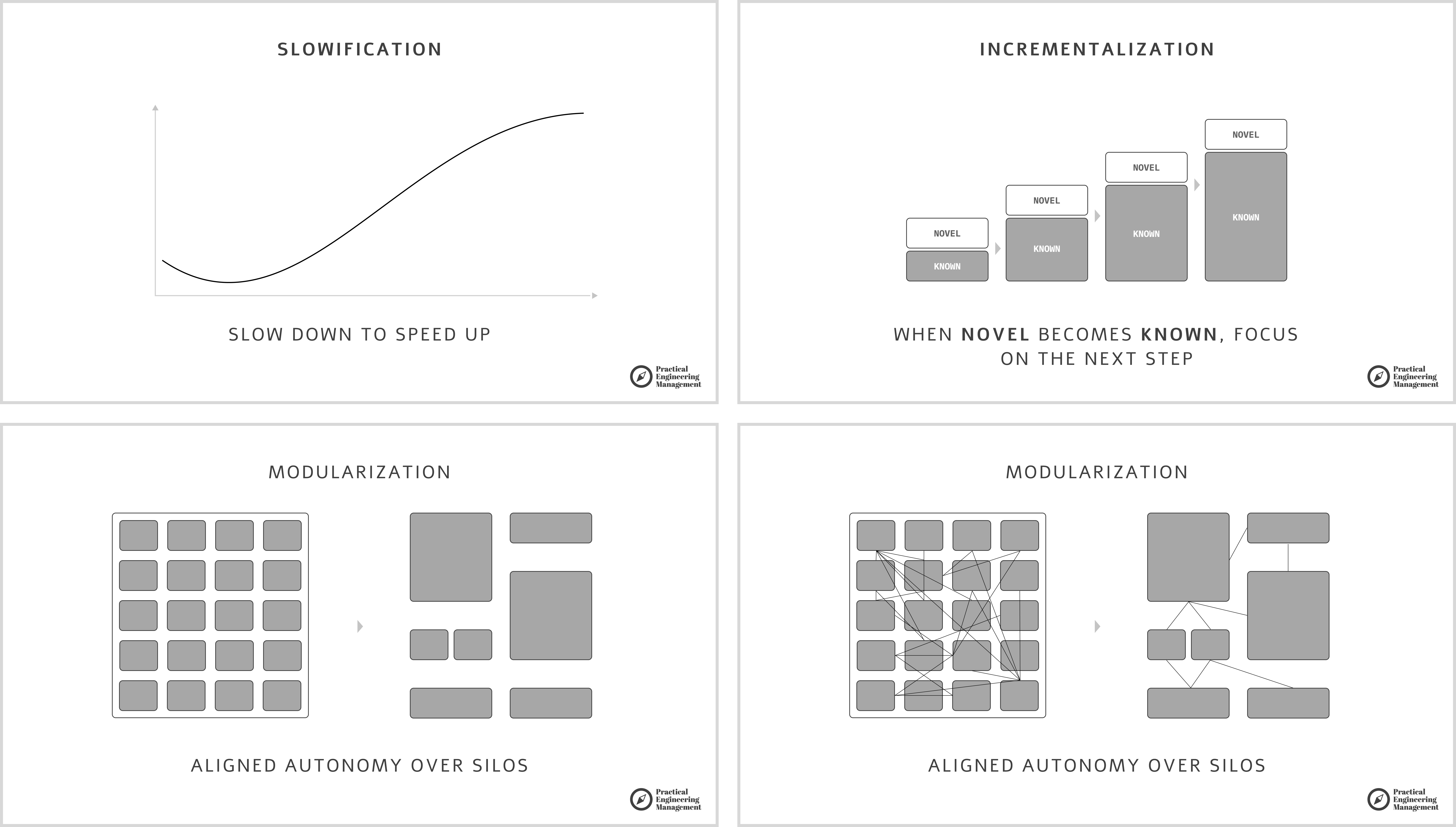
It was perfectly explained in Gene Kim’s book "Wiring Winning Organizations," which I covered in a cycle of articles that starts here: Slowification: The First Step to Transforming Your Engineering Organization.
Leverage Points
Recently, I’ve read one of the most foundational texts in systems thinking: Donella Meadows’ essay “Leverage Points: Places to Intervene in a System”.
It explains that every complex system (organizations, companies, teams, economies) has places where a small change can produce a disproportionate effect.
Meadows’ core thesis is that people intuitively know systems have “leverage points” (where a small shift produces a big change), but for engineering leaders, the key insight is slightly uncomfortable:
Most leaders intervene in the least effective places.
They change metrics, budgets, or org charts while the real leverage sits deeper in information flows, incentives, and beliefs.
The original leverage points, as described in the article:
PLACES TO INTERVENE IN A SYSTEM
(in increasing order of effectiveness)
12. Constants, parameters, numbers (such as subsidies, taxes, standards).
11. The sizes of buffers and other stabilizing stocks, relative to their flows.
10. The structure of material stocks and flows (such as transport networks, population age structures).
9. The lengths of delays, relative to the rate of system change.
8. The strength of negative feedback loops, relative to the impacts they are trying to correct against.
7. The gain around driving positive feedback loops.
6. The structure of information flows (who does and does not have access to information).
5. The rules of the system (such as incentives, punishments, constraints).
4. The power to add, change, evolve, or self-organize system structure.
3. The goals of the system.
2. The mindset or paradigm out of which the system — its goals, structure, rules, delays, parameters — arises.
1. The power to transcend paradigms.
Here is how you can translate Meadows’ 12 leverage points into actionable insights for engineering leadership, moving from the least to the most transformative interventions.
The entire article is available only for paid subscribers. You can use the training budget (here’s a slide for your HR). Thanks for supporting Practical Engineering Management!
