
We Are Done as Managers According to Anthropic
Are we?
A few weeks ago, Anthropic shared its economic research about the labor market impacts of AI.
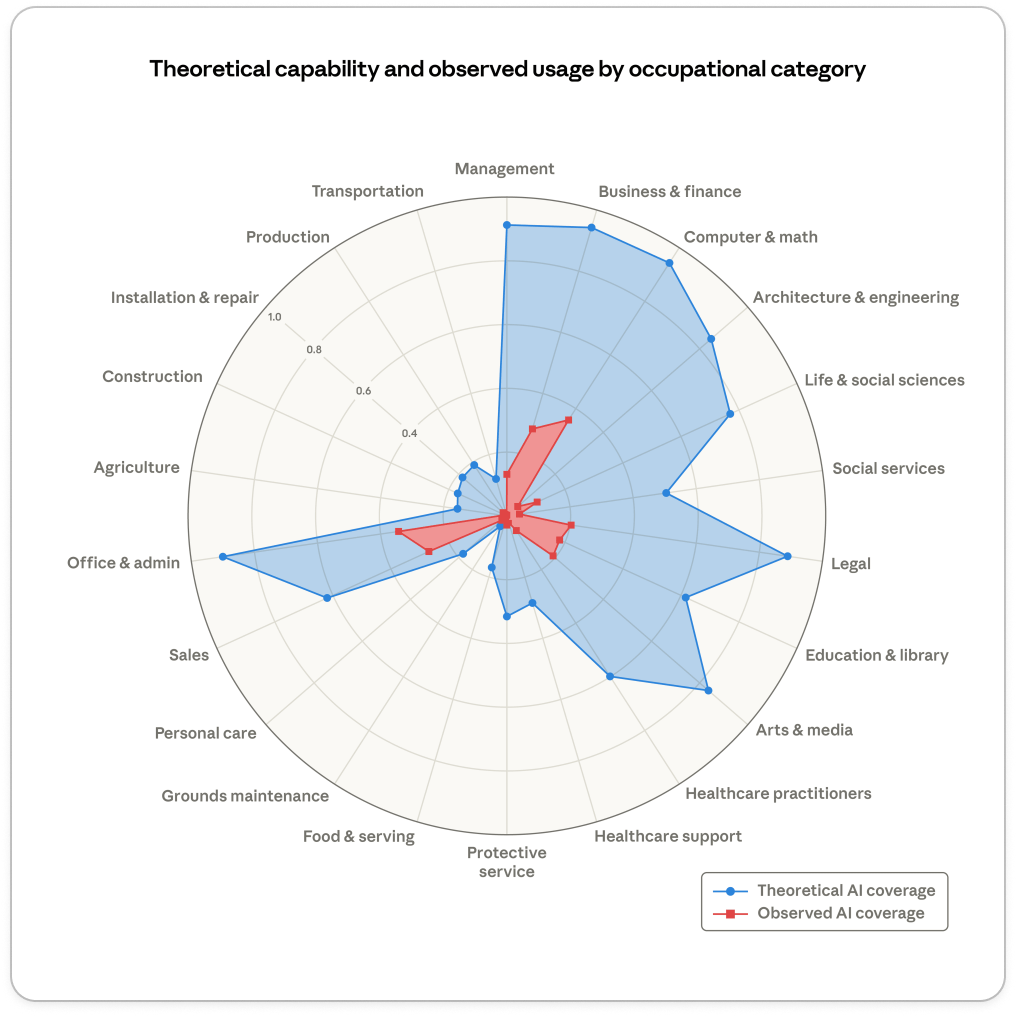
I have to admit, the chart of theoretical vs observed AI coverage stayed with me for longer. Math, computer science, admin & office, legal - I get these.
But management? Huh, that feels like a target on our back.
The worst part? After being in leadership for many years now, I can say Anthropic isn’t wrong here…
The Death of the “Human Jira Router”
For the last decade, a dangerous percentage of engineering managers have operated purely as transactional leaders.
You treat engineers as scarce “resources.” You observe signals, schedule tasks, constantly reassign priorities, and act as a gatekeeper for product requirements.
Let’s be brutally honest: if your primary value to your company consists of asking “any blockers?” in standup, moving Jira tickets from left to right, and aggregating status updates into a spreadsheet for the Director, the AI of today can do the same, but ten times faster.
Moravec’s Paradox and the Lie of “Hard” Skills
Formulated in the 1980s, Moravec’s paradox states a counterintuitive truth: high-level reasoning requires very little computation, but low-level sensorimotor and social skills require enormous resources. In robotics, playing grandmaster-level chess is easy; walking up stairs is incredibly hard.
In 2026, we are watching this play out in knowledge work. For decades, we assumed our “hard” skills—sprint planning, analyzing velocity, debugging legacy systems, and drafting strategy memos—were the peak of our intellectual value.
We viewed “soft” skills—navigating organizational politics, sensing team burnout, or having a difficult 1:1—as the fuzzy, secondary stuff.
AI just flipped the script. The “hard” stuff is highly compressible, pattern-based, and easily automated. AI can write a perfectly empathetic-sounding feedback email.
But it cannot sit in a room with a defensive senior engineer, read their body language, understand the unspoken context of their recent divorce, and navigate the conversation to a place of psychological safety.
It can generate 1,000 lines of code, but it cannot inspire a burned-out team of missionaries to care about a pivoting product roadmap.
Evolve or Get Automated
To survive, you must pivot from being a taskmaster to being an environment architect. You must become a Developmental Leader.
Developmental leaders do not ask, “How do we get these tasks done faster?” They ask, “How do we advance the frontier of what is possible for this team?”
You must Slowify: Give teams the context they need to think critically, rather than forcing them to react to tickets.
You must Simplify: Break down complex architectures so the problems themselves are easier to tackle.
You must Amplify: Build a culture of psychological safety where feedback is ruthless but kind, and problems are called out loudly, acknowledged, and acted on.
AI Needs a Human in the Loop (And That’s You)
The sheer volume of code generated in the coming years will be the highest in human history. Every junior developer with a Copilot license can bootstrap a microservice and generate 1,000 lines of edge-case test coverage in minutes.
But without human oversight, this isn’t productivity. It’s just noise.
Code is no longer the bottleneck; it is a liability. Your job is no longer to ensure code gets written—it is to ensure it is actually valuable, maintainable, and scalable. AI can act as a tactical coding assistant, but it cannot:
Own the Technical Strategy: An LLM doesn’t know if a monolithic architecture or microservices better align with your startup’s dwindling runway and 3-year vision.
Manage Complexity: Tesler’s Law dictates that complexity cannot be removed, only shifted. As AI makes it cheaper to generate features, system complexity will skyrocket. It is your job to proactively manage where that debt lives.
Foster True Ownership: You cannot automate accountability. A culture of “You Build It, You Run It” requires a human spine. An LLM won’t wake up at 3 AM to mitigate a catastrophic production outage and then drive the blameless post-mortem.
From Software Engineering to Product Engineering
Perhaps the most un-automatable skill of the modern leader is product discovery.
Let’s look at the grim reality of our industry: only 10% to 30% of features pushed by tech companies actually yield positive commercial results. If your only measure of success relies on operational DORA metrics (Deployment Frequency, Lead Time for Changes), you are likely just building the wrong things, very efficiently.
If you run a feature factory, AI will easily replace you. It’s the perfect worker for a factory line.
Good managers ensure the team knows why they are building, not just what. They shift their teams from software engineering to product engineering.
End Words
We don’t need fewer engineering managers. We need fewer glorified babysitters.
If your job is to translate documents into tasks, the Anthropic data is your death sentence. But if your job is to untangle human complexity, hold the line on technical strategy, and scale the problem-solving capabilities of the humans around you?
You aren’t done. You are finally free to do the actual work.


