


In Part 1, I introduced the User-Friendly Engineering Framework — a way for engineering leaders to reason about confusion, mental models, and behavior.
This article zooms in on just one element of that framework.
The most practical one.
The one you can run with your team next week.
The Friction Board.
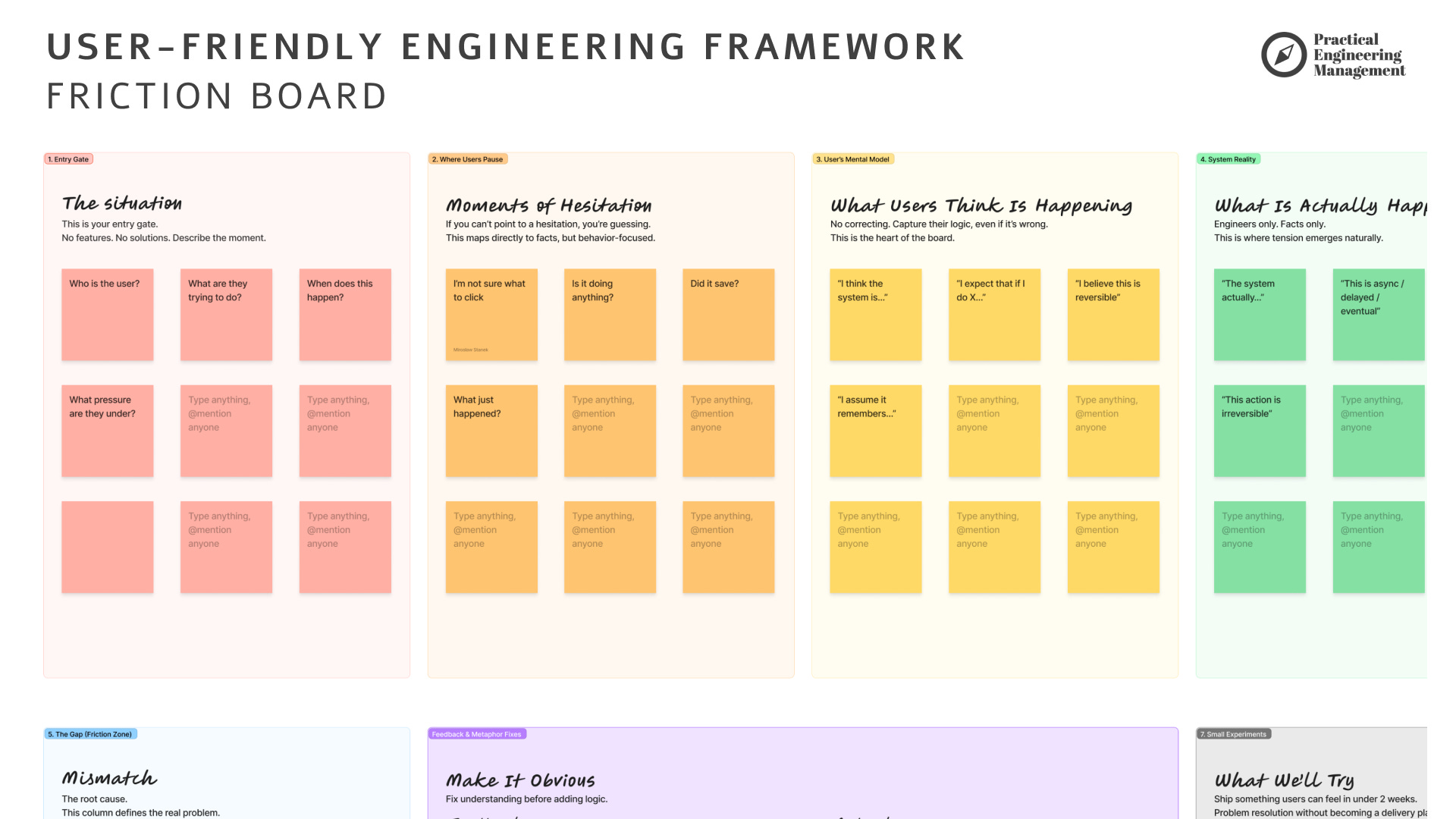
Where This Comes From
The Friction Board is inspired by the book User Friendly by Cliff Kuang and Robert Fabricant — and especially by Fabricant’s afterword:
“The World Seen Through the Prism of User-Friendly Design.”
That afterword reframes design not as aesthetics or usability tweaks, but as a way of shaping how people understand and act in the world.
This framework is my attempt to translate that idea into engineering language:
not taste
not opinion
but observable behavior and mental models
Most teams don’t struggle because they lack ideas.
They struggle because they solve the wrong problem, extremely well.
An engineer sees confusion and thinks:
We need clearer logic.
A product manager sees confusion and thinks:
We need a better flow.
A designer sees confusion and thinks:
We need better copy.
The Friction Board exists to find the common language.
What the Friction Board Is (And Is Not)
The Friction Board is not:
a feature ideation workshop
a UX critique
a backlog grooming session
It is an observation tool.
A way to surface one sentence:
“This feels hard because…”
Before anyone proposes how to fix it.
The entire article with The User-Friendly Engineering Framework materials is available only for paid subscribers. You can use the training budget (here’s a slide for your HR).
Thanks for supporting Practical Engineering Management!
