


Part I: The Chaos
You start your day, open your laptop to navigate to your favorite place, and…
JIRA is gone.
Just like that. The paralysis is immediate.
You don’t know what to do anymore. You are 50% of the way through coding a new feature, but you realize you don’t actually know what the feature does for the business.
That wasn’t your call anyway; it was the PM’s.
You read smart IT books - The PM decides the WHAT (or maybe the WHY?? 🤔 - never mind). You do the HOW.
You are about to write a money-calculation service, but you’ve lost the exact requirements. You aren’t sure how important the decimal points are. Should it handle 1 USD? What about 1 million USD? What about a single cent? It doesn’t matter right now—let’s just wait for the frontend team so you can see the UI behind your work.
Let’s put your work on HOLD.
But wait. There is no JIRA. How can you formally signal that you are blocked? You don’t even know if the frontend work was estimated at 5 story points or 13.
Don’t think about it right now. Good that you have another branch open. In this moment of uncertainty, while waiting for the PM to answer your questions, you decide to finish an old, forgotten feature. Without JIRA, you don’t have to explain the business value or the context anymore.
Good ol’ coding time 🤓
After a day, the task is ready. Let’s open a PR and push it. But wait! You cannot issue a PR because there is no JIRA ticket to link it to. No change management evidence in the logs, and the “Create PR” automation button is gone.
Good thing you have your AI tooling. “Hey Claude, create a pull request for me via the GitHub CLI.”
The PR is up.
Meantime, the PM approaches you:
-“Have you finished your work on this task?”
- “Yes, I have.”
- “Where can I see it?”
Oh here we go again. You explained it a million times. They can it in the code!
- “Why not working product? Can I see it in our interface in staging env?”
Well, they can’t. No one has reviewed your code yet. If you had JIRA, you would normally just set the status to IN REVIEW (and blame the others that they haven’t reviewed it yet).
And then IN TESTING, STAGING DEPLOYMENT, and finally DONE.
Anyway, you do backend no? You only expose the API. You have absolutely no idea who will start consuming it and when 🤷. Without JIRA, you don’t even know if the UI work was picked up yet…
Then comes the worst part. No JIRA means no story points. No burn-down charts.
What’s even worse - your code got stuck in the review process, and it seems the feature isn’t that critical to the CEO anymore; the final release might be postponed by a few weeks.
This is bad for your performance.
The epic you just closed was worth 23 story points. Normally you deliver 15, but a few big blocks went faster than predicted, so your performance was 50% higher this sprint. But you have no JIRA, and now no one can tell you were busy enough.
Then comes the realization. No story points, no burn-down charts. No one will ask you why the line was flat for eight out of ten days and plummeted in the last two days of the sprint.
Dragging tickets through statuses is the least important thing for you anyway. You’ve always preferred spending time on quality improvements. Then, close to the sprint ending, you run your “office day” for two to four hours just to update all the JIRA tickets at once. Smart 😏
But the Scrum Master - or maybe the Project Manager (you don’t remember his role) - he hates you for that.
-“The tool is for you, you are not for the tool,” they say.
Right. Because debating 5 versus 7 story points surely helps you architect solutions for the hardest problems.
But none of that matters anymore. Even when JIRA was active, you already had a few AI skills writing the tickets for you.
For a simple background color change, the AI would generate the entire I.N.V.E.S.T. structure. (Do you even remember what that acronym stands for? Something about (N)egotiable and (I)ndependent? You don’t read it anyway; it’s just a formality. A record in the history that no one reads.)
Then your CI/CD webhooks took over: branch created → IN REVIEW; merged to staging → IN TESTING; merged to main → DONE.
You think back to the “great times” before AI. Your PM created bunches of [PLACEHOLDER] tickets with no descriptions. Some had a screenshot pointing to a particular item in the UI. The more ambitious ones added a link to a Figma board with the caption, “Implement this 👉.”
That link opened an entire storyboard with 17 screens, forcing you to ask a designer to export a few PNGs via Slack just so you could attach them to the original ticket for the record.
Those empty-description tickets were a nightmare. PMs would drop dozens of them right before roadmap planning, asking for effort estimations so the quarterly plan was complete. You pushed back—it wasn’t your business to guess—so the PM spent another night filling them in and came back the next day.
Then someone had a brilliant idea: let’s make the “Description” field mandatory. No more placeholder tickets, no more back-and-forth estimations.
And who is the best at creating content today? ChatGPT.
Suddenly, half the tickets are full pages generated by AI in response to a prompt:
“Here’s the screenshot of the functionality, create a JIRA ticket through the Atlassian MCP that meets all modern ticket standards, including the WHAT, WHY, HOW, acceptance criteria, and edge cases.”
On the receiving end sits the engineer. Do they read the ticket? Surely not.
“Hey Claude Code, read ticket DEV-123. Extract the requirements. Go to repo my-service-123, implement the code, run tests, create a PR, and set the ticket to IN TESTING.”
Agents talking to agents through tickets.
...Maybe it’s not that bad that there is no JIRA anymore?
Part II: The Awakening
The next day, you are back to work.
Still no JIRA.
And then it hits you—do you really need a ticket to build something valuable? Let’s see.
You start the day early, around 7:30 AM. You like this rhythm; it gives you an hour or two of undisturbed focus. Normally, you would pick some easy wins from the JIRA board—something you can deliver quickly to get that dopamine hit.
Today, you start your day by reviewing telemetry.
You open the night alerts. Nothing major, but there is a noisy anomaly you promised yourself to check in a free time, 2 months ago: 128 Null Pointer Exceptions on your user-service. A user fills out a form; there is no data validator, so it hits your service with a null value. The NPE is handled on the frontend, so the user doesn’t even know something is breaking behind the scenes.
Let’s dig deeper. “Claude, here’s the alert ID: #34davd. Check Datadog for related logs and use the GitHub CLI to identify what’s wrong in the code. Can we do anything with this noise?”
“Out of 128 cases of NullPointerException, 27 are actually your service’s fault. You expect data will come as ‘YYYY-MM-DD’, but some users send ‘DD/MM/YYYY’, which causes the NPE.”
Wait. You heard about this issue from the Ops team. Dozens of users haven’t been able to save their data, even though they say they filled out the forms correctly.
Those 27 cases mean someone in Operations is manually updating the data on behalf of those users.
“Claude, create a Pull Request that handles missing date formats.”
8:54 AM: Created, reviewed, merged. Because there is no JIRA, you don’t even need to create a corresponding ticket. Everything is documented in the PR description anyway. By 9:00 AM, the fix is merged and pushed to production.
Thirty minutes of your time just eliminated one to two hours of daily manual work for the Ops team.
At 9:30 AM, you jump into a brainstorming session with your Product Manager. JIRA is not available, so you try to figure out the most valuable thing you can deliver together.
You look at user form conversion. Opening Mixpanel, the PM shows you the dashboards. Of 10 people who open the form, only two finish it within the same 30-minute session. Two more complete it on their own within the next 14 days. The rest have to be handled by admins or Ops.
Your objective for this quarter is to ensure that over 50% of users complete the form within the first 7 days.
Normally, you would wait for the requirements and use cases to be handed down so you could build features the TDD way. But without JIRA, you approach it from the other direction.
You pull data from the observability platform and product analytics: service logs, frontend real-time user monitoring, 4xx errors, core web vitals, behavioral events, and user demographics.
“Antigravity, give me an executive summary of the user journey based on this data.”
Here it goes:
20% successfully finish the form.
5% who failed encountered the NPE you just fixed. (hah, you delivered business value not even knowing you delivered it 😎)
10% (all from a single country) get a validation error on a single field. They don’t know why, because they only see a generic “your data is incorrect” pop-up.
10% drop off, come back within 5 days, but for some reason they start over from scratch.
3% are expected to fill in information field that simply doesn’t exist in their country.
In the old world, each of these bullet points would be a separate JIRA ticket with a full lifecycle, grooming, estimations, and planning sessions. But the longer you look at the raw data, the more confident that these can be handled in the next 2-3 days without much debate. Better error handling, fixing a bug in data validation, updating schemas—it’s not rocket science.
The PM is impressed. For the first time, you are creating the requirements, not her.
But she also brings her own hypotheses to the table. The form is quite complex, so they’ve decided to bring in real humans for user testing.
They want to show them two interface mocks: the current long form with some minor UI tweaks, and a new concept split into subpages with a progress bar and immediate feedback.
“When is the testing day?” you ask. “Three days from now.”
You do quick math. You have a well-documented design system, a micro-frontend scaffolder, and AI tools that can help you spin up two functional, clickable PoCs in the next few hours.
No JIRA, no formalities.
If the UX works, you’ll use it as the bootstrap for the actual production feature. If it fails, you throw it away and move on.
In three days, the users won’t be clicking through a static mock. They will be interacting with something that looks, feels, and behaves exactly like your production-grade software.
…
Part III: The Enlightenment
The narrative above blends my or my teams’ real experiences.
Across all of them, one common thread remains: JIRA, and the heavy project management surrounding it, has increasingly become an obstacle rather than an enabler.
Undoubtedly, Scrum and its associated tooling brought structure to chaos in the past. But they also brought a massive overhead. More dangerously, a rigid ticketing system makes it incredibly easy to outsource thinking.
The phrase, “I will not work on that until I get clear requirements,” is often just a professional way of saying, “Tell me exactly what to do.” It is a formalized pushback against taking real responsibility for the product being built.
Two-week sprints, daily standups, story point estimations, and the relentless pursuit of predictability—these concepts worked nicely when we treated software development like a manufacturing line.
But in an era where AI generates code in seconds, is the assembly-line analogy still valid?
We have already learned how to hack this system. We know exactly how to make burndown charts look perfectly linear. Our CI/CD scripts swipe tickets neatly across columns, and our AI agents write the exhaustive ticket descriptions for us. It is a perfectly optimized theater of work.
Consider a fun fact 👉 Anthropic, OpenAI, and other AI leaders have all built robust JIRA integrations into their platforms. Yet, none of them actually do Scrum.
Look inside their engineering organizations, and you won’t find them dragging tickets across two-week sprint boards to measure velocity. They build these integrations because the rest of the corporate world is still addicted to the bureaucracy, but they do not operate that way themselves.
That alone says something, doesn’t it?
Look at what happens in your own company when a massive opportunity arises—when the CEO walks in and says, “This must be done for yesterday.”
We don’t schedule a backlog refinement session. We don’t meticulously draft JIRA epics. We bypass the board entirely. We form a rapid task force, or we take a single full-stack engineer, equip them with the latest Astra or Fable model, bump their token limit to $2k, and let them work completely uninterrupted.
Today, momentum beats rigid ceremonies. Builders beat specialized task runners.
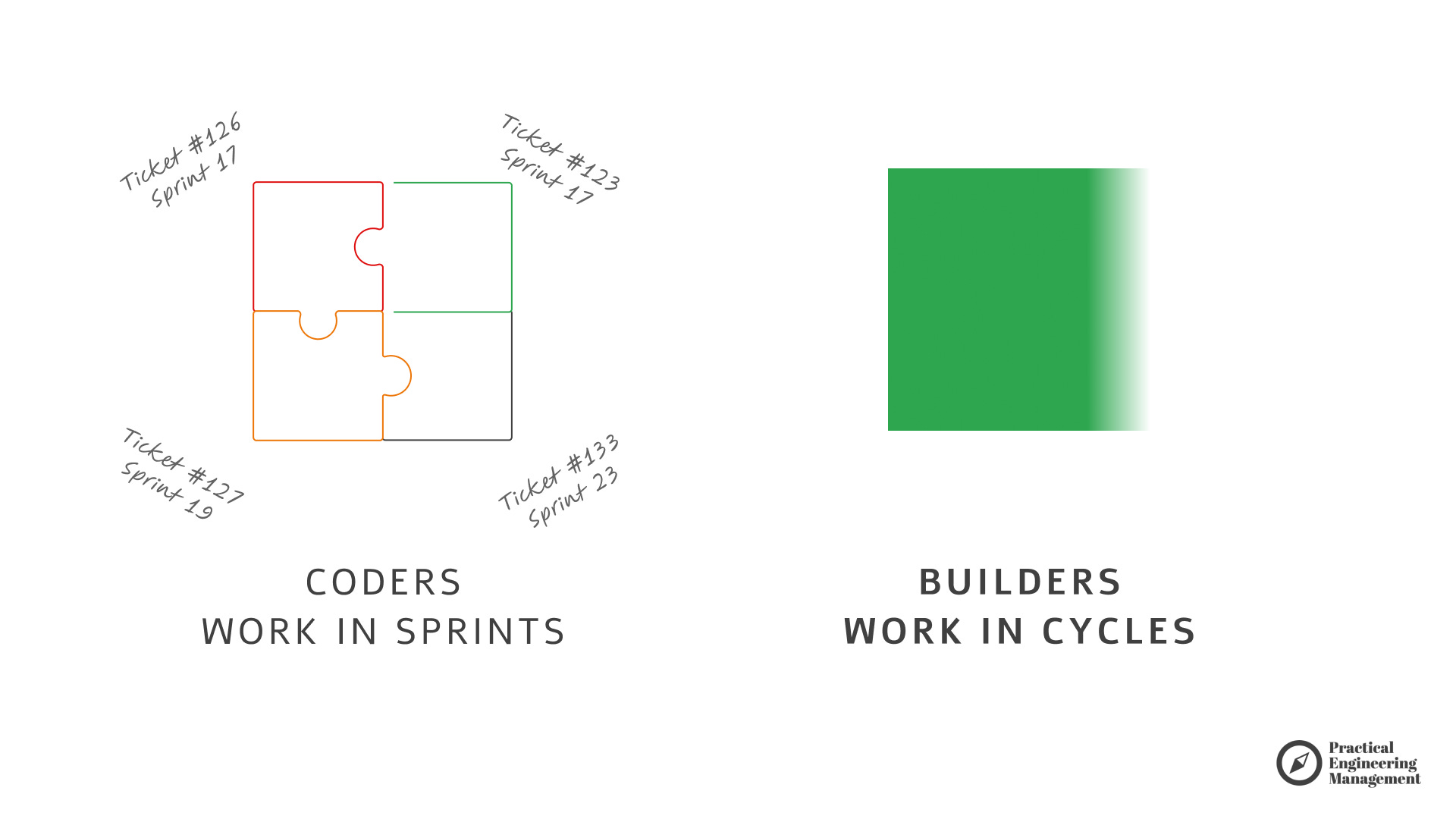
The winners in this new era are the ones who take all their domain know-how, multiply it by AI, and invest every ounce of effort into making the company successful.
And in a world where builders have direct access to telemetry, user analytics, and instant prototyping, who the hell is a scrum master?
The best part is that this underlying shift isn’t entirely new; AI is simply the catalyst finally making it a reality.
If you want to explore how to navigate this transition from traditional coder to product-minded engineer, here are a few supplemental reads on what comes next:
The first thing that happened was: I smiled.